Pokémon Team Planner
Each game opens the planner with the correct dexes, mechanics, forms, and type chart for that generation.
Pokémon Team Planner for Balanced Playthrough Teams
This Pokémon team planner and team builder helps you check weaknesses, resistances, and type coverage for playthrough teams across mainline Pokémon games. Choose a game, add the Pokémon you want to use, or start with a random team for quick inspiration, then review whether the team has clear balance issues before you keep playing.
How to Check Your Team Balance
Use the Pokémon Team Planner to build or randomize a team, then review its weaknesses, resistances, and type coverage. You do not need a perfect team to enjoy a playthrough, but these checks can show where one or two changes would make the team easier to use.
-
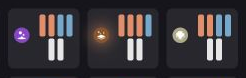
Weaknesses example image unavailable Avoid Shared Weaknesses
If several Pokémon are weak to the same type, that matchup can become harder than it needs to be. Start by looking for repeated red marks in the defense analysis.
-
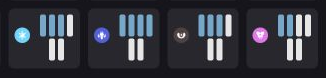
Resistances and immunities example image unavailable Find Resistances and Immunities
A balanced team usually has Pokémon that can safely take common attack types. Blue marks help show where your team has resistances or immunities.
-
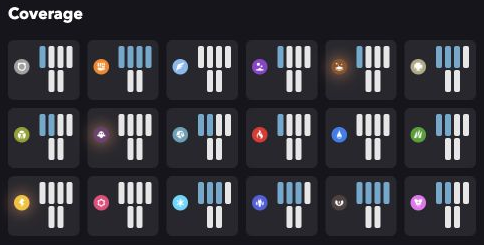
Offensive coverage example image unavailable Check Offensive Coverage
Coverage shows which opposing types your team can hit effectively. Look for empty or thin areas before deciding whether one slot needs a better matchup.
Tip: Keep the Pokémon you like, then adjust one or two slots that create the biggest weakness or coverage gap.
FAQ
- Does the planner include every Pokémon form?
-
The planner covers almost every Pokémon form. A small number of cosmetic and transient forms are hidden by default and only appear when the "Misc. Forms" filter is selected.
Forms for these Pokémon are not included in the planner: Pikachu, Genesect, Pumpkaboo, Gourgeist, Xerneas, Mimikyu, Cramorant, Sinistea, Polteageist, Zarude, Poltchageist, and Sinistcha.
- What does the "Misc. Forms" filter show?
-
"Misc. Forms" is an unofficial, arbitrary grouping used to keep the planner from becoming cluttered. It includes most cosmetic forms, such as Vivillon patterns and Furfrou trims.
The group also includes forms of Arceus and Silvally, plus battle-only forms such as Ash-Greninja and Original Color Magearna. These forms start hidden and can be shown by turning on the corresponding filter.
- Why aren't some gender differences simple toggles?
-
Some gender differences are handled as separate Pokémon instead of simple toggles. Meowstic, Indeedee, and Basculegion have forms with differences beyond appearance, including different movepools, abilities, and/or stats.
Because those differences affect how the Pokémon works, the planner treats them as distinct Pokémon, similar to Nidoran♀ and Nidoran♂.
- How does the planner calculate team analysis?
-
The team analysis is based only on type. A Pokémon's weaknesses and resistances are calculated from its type, while abilities such as Levitate or Wonder Guard are not included in the calculation.
Coverage is calculated the same way: it uses type and does not check movepool. For example, Pyukumuku is counted as contributing to Water-type coverage even though it cannot learn any Water-type damaging moves.
- Does the planner consider moves, abilities, items, EVs, or IVs?
-
No. The planner focuses on type-based analysis: weaknesses, resistances, immunities, and type coverage.
It does not evaluate movesets, abilities, held items, EVs, IVs, or competitive meta. Random Team is only a quick starting point for inspiration, not an optimized team recommendation.